
 Spot HR
Employee Mileage Reimbursement for Small Businesses: A Practical Policy and Claim Process
Posted September 2, 2026 by Spot HR ‐ 9 min read
When employees use their own cars for client visits, errands, or travel between work locations, the cost should not disappear into a vague expense line. A clear mileage reimbursement process helps employees record business travel consistently, gives managers enough detail to approve it, and keeps finance from rebuilding every journey at month-end.
Mileage claims need more than a number
Mileage reimbursement sounds simple: record the distance, multiply it by a rate, and repay the employee. In practice, most confusion happens before that calculation.
Was the journey genuinely for work? Does the normal commute count? Which distance should the employee record? What rate applies? Who approves the trip, and what information does finance need before reimbursement?
When the answers live in different emails, employees make reasonable but inconsistent choices. One person submits fuel receipts, another enters a round number in a spreadsheet, and a third waits until the end of the quarter to reconstruct several journeys from their calendar. Managers then approve claims without enough context, while finance spends time checking calculations.
A practical process connects four things:
- a clear mileage reimbursement policy
- a consistent record of each business journey
- an automatic distance-by-rate calculation
- an approval trail alongside other employee expenses
The aim is not to monitor every movement. It is to give employees a fair, predictable way to claim legitimate business travel.
What is employee mileage reimbursement?
Employee mileage reimbursement is the repayment of costs associated with an employee using a personal vehicle for an eligible work journey. Many businesses calculate it by multiplying the approved business distance by a mileage or kilometre rate.
A simple calculation looks like this:
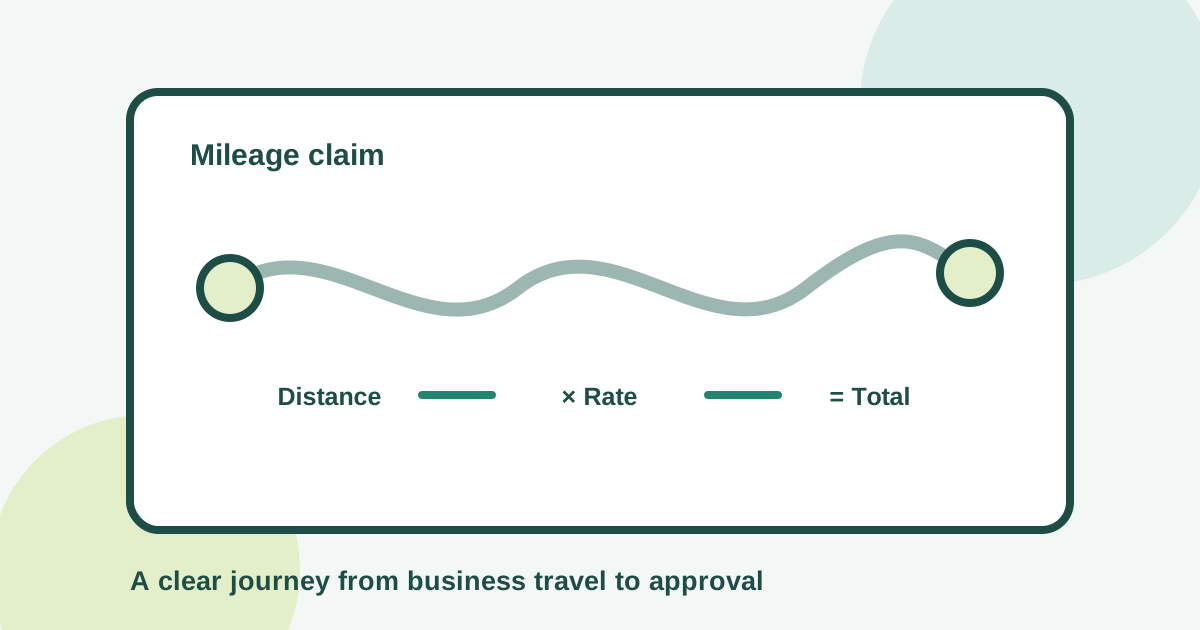
The formula is eligible business distance × approved rate = reimbursement amount.
For example, an employee records the distance travelled for a client visit and the rate defined by the company’s policy. The claim calculates the amount from those two values, rather than asking the employee or approver to work it out manually.
Rates, tax treatment, evidence requirements, and the journeys that qualify vary by country and sometimes by region. Published rates may also change. Treat official local guidance and appropriate payroll or tax advice as the source of truth for your business. Your internal process should make the approved rule easy to apply, not replace that guidance.
Define which journeys are eligible
The most important part of a mileage policy is a plain-language explanation of eligible business travel. Without it, even a perfectly accurate calculation can reimburse the wrong journey.
Depending on your local rules and company policy, examples may include:
- travel from a normal workplace to a client or supplier
- journeys between two work locations
- an approved trip to collect equipment or supplies
- travel to an off-site meeting, event, or training location
- another journey made specifically for an agreed business purpose
The normal journey between home and a regular workplace is often treated differently from business travel. Do not leave employees to infer the difference. Explain how your policy handles commuting, home-based employees, temporary workplaces, detours, parking, tolls, and journeys shared with another employee.
Avoid copying a generic policy from another country. A search result that quotes a rate or tax rule may be correct for a particular location and year but wrong for your team. Link your policy to the official guidance you rely on, name the person who owns it, and review it on a regular schedule.
What should a mileage claim include?
A manager should be able to understand a claim without opening a separate chat thread. At minimum, ask employees to record:
- the date of the journey
- the business purpose
- the relevant destination or route
- the eligible distance travelled
- the mileage or kilometre rate used
- the calculated reimbursement amount
- any related costs handled separately, such as parking or tolls
- any evidence required by company policy or local rules
Collect enough information to explain the business expense, but do not turn every short journey into a writing exercise. A description such as “client planning meeting at Bristol office” is more useful than “travel” and still concise.
Be equally clear about privacy. A reimbursement record should document the business journey. It does not automatically need continuous location tracking or a detailed history of personal travel. If the business uses GPS-based mileage tools, explain what is collected, when tracking operates, who can see the data, and how employees separate personal journeys.
Build a simple mileage reimbursement process
A small business rarely needs a complex travel and expense programme. It does need one route that employees and managers can follow consistently.
1. Publish one policy and one current rate
Put the policy somewhere employees can find before they travel. It should explain:
- who can claim mileage
- which journeys are eligible
- when pre-approval is required
- the rate or method the business uses
- how to measure and round distance
- what supporting details are required
- the deadline for submitting claims
- who reviews and approves them
- when approved expenses are normally reimbursed
Record the effective date whenever the rate changes. This avoids arguments about whether an old or new rate applies to a journey near the changeover.
If the business operates in several countries, do not force one rate or rule onto every employee. Maintain the applicable policy by location and make it obvious which version an employee should use.
2. Record each journey while it is still clear
Mileage claims become unreliable when employees recreate a month of travel from memory. Encourage people to record a journey shortly after it happens, or save it in a draft expense claim until they are ready to submit.
A draft is useful when an employee makes several trips during a week or client visit. They can add line items as they go, check the details later, attach any related receipts, and submit one complete claim. Managers should not receive half-finished claims simply because the employee needed somewhere to save progress.
3. Calculate distance multiplied by rate consistently
Manual formulas invite small errors. Employees may reverse the values, use a stale rate, mistype a decimal, or calculate one line differently from another.
Use a structured travel line item with separate fields for distance and rate. The system should calculate the total as distance multiplied by rate. Spot HR supports kilometre-based travel expense lines and calculates the amount from the entered kilometres and rate, without applying VAT to that travel line.
The software can make the calculation consistent, but the business still owns the policy decision. An automatically calculated amount is only correct when the distance and rate are appropriate.
4. Send the complete claim to the right manager
A manager should review the purpose, distance, rate, and supporting detail together. Keep the approval path proportionate. Most small teams need one responsible manager, with a separate route for unusual, high-value, or manager-submitted claims.
The approver should check:
- the journey has a clear business purpose
- the distance looks reasonable for the route
- the correct policy and rate were used
- the claim is not a duplicate
- related receipts or documents are present where required
- any exception is explained and handled consistently
Approval should be an actual status change, not a thumbs-up in chat. A visible claim record gives the employee, manager, and finance team the same answer about what is pending, approved, rejected, or withdrawn.
5. Keep reimbursement timing predictable
Employees have paid a business cost personally, so uncertainty creates understandable frustration. State when claims must be submitted and when approved claims move to payment.
A predictable weekly or monthly cycle is usually better than an undefined promise to handle expenses “soon”. If a claim is rejected, provide a useful reason so the employee knows whether to correct the journey, rate, or supporting information.
Common mileage reimbursement mistakes
Treating a fuel receipt as a mileage record
A fuel receipt shows that fuel was purchased. It does not, by itself, show which distance was travelled for work or whether part of the fuel related to personal use. If your policy uses a distance-based rate, ask for the journey record required by that method rather than mixing it with an actual-cost calculation.
Using a rate without an effective date
Rates can change. A spreadsheet with one editable rate cell can silently recalculate old claims or cause employees to use different values. Preserve the rate applied to each submitted line and document when a new policy takes effect.
Combining all travel into one monthly line
“Business mileage, 420 km” gives an approver very little to review. Separate journeys, or provide a clear attached log, so the purpose and distance can be understood without detective work.
Approving in one place and recording in another
When approval happens in email but the expense lives in a spreadsheet, nobody has a complete record. Keep the decision with the claim and its line items.
Creating excessive surveillance
Accurate reimbursement does not require unlimited access to an employee’s location. Choose evidence that is proportionate to the travel pattern, the value of the claim, local requirements, and the company’s privacy responsibilities.
A practical mileage reimbursement policy checklist
Use this checklist to review your current setup.
Policy
- eligible and ineligible journeys are explained with examples
- commuting, home working, parking, and tolls are addressed
- the mileage or kilometre rate and effective date are visible
- local tax, employment, and recordkeeping requirements have been checked
- employees know when travel needs advance approval
Employee claim
- each journey has a date and business purpose
- distance and rate are stored separately
- the total is calculated consistently
- employees can save drafts before submission
- required supporting details are attached or recorded
- there is a clear submission deadline
Approval and payment
- every employee knows who approves their claim
- managers review the journey details, not only the total
- exceptions and rejected claims include a reason
- claim status remains visible after submission
- reimbursement follows a published schedule
- completed records can be found without searching inboxes
How Spot HR supports travel expense claims
Spot HR keeps kilometre-based travel reimbursement inside the same expense claims workflow used for other employee expenses. An employee can create a draft, add travel line items with kilometres and a rate, and have the total calculated automatically. Regular expense lines, supporting receipts, and travel can sit together where that makes sense.
When the claim is ready, the employee submits it for manager review. Approvers can open the claim details, inspect line items and receipt files, then approve or reject it. Employees can follow the status and retract a submitted claim if it needs to be withdrawn. Account details are masked in the interface rather than displayed in full.
This does not decide which journeys your company should reimburse or what local rate applies. It gives the policy a consistent workflow: draft, calculate, submit, review, and retain the result in one place.
Read our broader guide to setting up an expense claim approval process, explore expense claims for startups, or sign up for Spot HR to try a clearer reimbursement process with your team.
Final takeaway
A reliable employee mileage reimbursement process begins with policy, not a calculator. Define eligible journeys, publish the applicable rate and effective date, ask for a concise business record, and keep approval with the claim.
Then make the routine work easy. Let employees record journeys while the details are fresh, calculate distance multiplied by rate consistently, give managers enough context to decide, and keep reimbursement timing visible. Small businesses do not need more expense admin. They need a fair process that everyone can understand and repeat.